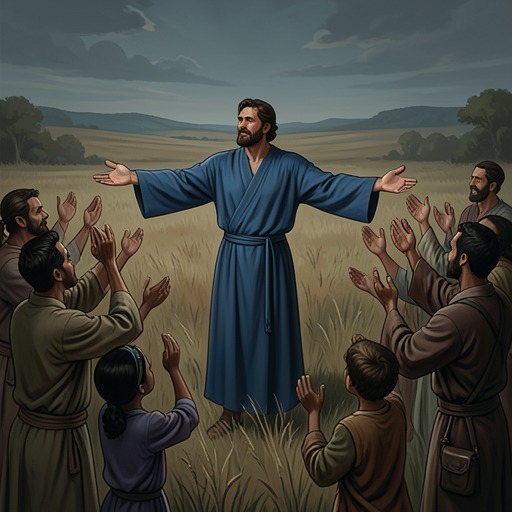
Elisha raises the Shunammite woman’s son
Don't Leave God Alone: How to Get God's Attention, Remain in His Presence, and Even Change His Mind to Make a Difference in Your WorldElisha raises the Shunammite woman’s son, turning the child’s death into one of the clearest demonstrations of prophetic power in the book’s catalogue of miracles. The episode is presented not merely as a report of recovery, but as a model of how persistent trust in God can confront apparently irreversible loss and bring what has died back to life.
Background and the Child’s Death
The miracle belongs to the sequence associated with Elisha after he has passed through the places of testing and begun to operate in extraordinary ways. In the book’s presentation, the Shunammite woman was previously barren but received a son after Elisha prophesied that she would bear a child. The birth therefore represented the fulfillment of a prophetic word and the arrival of fruitfulness where there had previously been barrenness.
That reversal later became the setting for a more severe reversal: the boy died. The narrative consequently moves from promised life, to fulfilled promise, and then to apparent destruction. The child’s death makes the event more than a general healing story; it confronts the collapse of a blessing that had already been received and places the question of restoration at the center.
Elisha’s Act of Restoration
The book states that the woman came to Elisha while still believing that all was well. Her response is treated as an expression of faith that refused to surrender to the visible condition of death. Rather than allowing the loss to close the story, she returned to the prophetic source through whom the child had first been promised.
Elisha then acted with the power of God and raised the boy back to life. The account is summarized as a dead son being brought to life, with the restoration presented as a direct manifestation of divine power working through the prophet. Life, which had moved from impossibility to fulfillment and then into death, was restored once again.
Consequences and Spiritual Application
The event is used to extend the meaning of resurrection beyond the child himself. The book declares that the power of God can bring dead things back to life for the person who carries that power and for others as well. The boy’s restoration thus becomes a pattern for the recovery of things that appear finished, barren, poisoned, lost, or beyond human repair.
This interpretation is reinforced by the surrounding miracles attributed to Elisha. The same sequence includes the Jordan River being parted, polluted water being healed with salt, water being supplied in a valley without wind or rain, a widow’s oil being multiplied, poisoned stew being neutralized, and an axe head being made to float. Within that sequence, the Shunammite woman’s son represents the most dramatic form of reversal: not merely provision or repair, but the return of life after death.
The episode also supports the book’s wider teaching on persistence in prayer. Readers are urged not to give up when they have failed, when circumstances appear final, or when prayer seems unanswered. The book defines importunity as being shameless, bold, determined, pressing, entreating, and persistent in requesting, and presents the Shunammite woman’s continued belief as consistent with that posture. Her story is therefore placed alongside Jacob’s refusal to leave God until blessed, Moses’ intercession that changed God’s announced judgment, Hezekiah’s prayer for fifteen additional years of life, the Syrophoenician woman’s persistence for her daughter, and blind Bartimaeus’s refusal to stop calling to Jesus.
Narrative and Religious Significance
The decisive value shift is from death to restored life. The child’s death appears to confirm that a fulfilled promise can still be lost, but Elisha’s intervention overturns that conclusion and makes resurrection the event’s final meaning. The story therefore functions as both testimony and exhortation: it offers the raised child as evidence of God’s ability to reverse impossible conditions and calls believers to continue seeking God rather than abandoning prayer after disappointment.
The book repeatedly urges readers to refuse to leave God alone, to use the Word of God and the name of Jesus, to believe that God desires freedom, to stand firm, and not to give up on deliverance. In this framework, the Shunammite woman’s persistence is not passive optimism. It is a determined refusal to let death, failure, or apparent finality define the outcome.
The episode also contributes to the book’s personal appeal. Readers are told that issues troubling them can stop and that dead things can come back to life; they are urged to initiate contact with God’s power and to continue pressing in until their circumstances change. The son’s resurrection consequently becomes a bridge between biblical history and present expectation: the ancient miracle is presented as a promise-shaped example of what God’s power can still accomplish for believers and through them.